Norm and Form Studies in the Art of the Renaissance Sumamry
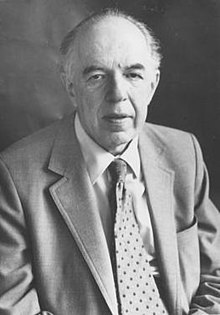
| Sir Ernst Gombrich | |
|---|---|
 | |
| Born | 30 March 1909 (1909-03-30) Vienna, Austro-hungarian empire |
| Died | iii Nov 2001 (2001-11-04) (aged 92) London, England |
| Occupation | Art historian |
| Notable work | The Story of Art |
Sir Ernst Hans Josef Gombrich OM CBE FBA (; German language: [ˈgɔmbʁɪç]; thirty March 1909 – 3 Nov 2001) was an Austrian-built-in art historian who, after settling in England in 1936,[1] became a naturalised British citizen in 1947[two] and spent virtually of his working life in the Great britain.
Gombrich was the writer of many works of cultural history and fine art history, most notably The Story of Art, a book widely regarded as one of the well-nigh accessible introductions to the visual arts,[3] and Fine art and Illusion,[4] a major work in the psychology of perception that influenced thinkers as diverse as Carlo Ginzburg,[five] Nelson Goodman,[6] Umberto Eco,[7] and Thomas Kuhn.[viii]
Biography [edit]
The son of Karl Gombrich and Leonie Hock, Gombrich was born in Vienna, Austro-hungarian empire, into an assimilated conservative family of Jewish origin who were part of a sophisticated social and musical milieu. His father was a lawyer and former classmate of Hugo von Hofmannsthal and his mother was a distinguished pianist who graduated from the Vienna Conservatoire with the Schoolhouse's Medal of Distinction. At the Conservatoire she was a educatee of, amid others, Anton Bruckner. However, rather than follow a career as a concert pianist (which would have been difficult to combine with her family life in this menstruum) she became an assistant of Theodor Leschetizky. She also knew Arnold Schoenberg, Gustav Mahler, Hugo Wolf and Johannes Brahms.[9] Rudolf Serkin was a shut family friend. Adolf Busch and members of the Busch Quartet regularly met and played in the family unit home. Throughout his life Gombrich maintained a deep love and knowledge of classical music. He was a competent cellist and in later life at home in London regularly played the bedchamber music of Haydn, Mozart, Schubert, Beethoven and others with his married woman and his elder sis Dea Forsdyke, a concert violinist.
Gombrich was educated at the Theresianum and at Vienna Academy, where he studied art history under Hans Tietze, Karl Maria Swoboda, Julius von Schlosser and Josef Strzygowski, completing a PhD thesis on the Mannerist architecture of Giulio Romano, supervised by Von Schlosser. Specialized in extravaganza, he was invited to help Ernst Kris, who was so keeper of decorative arts at the Kunsthistorisches Museum, on his graduating in 1933.[10] In 1936 he married Ilse Heller (1910–2006), a pupil of his mother, and herself an accomplished pianist. Their but kid, the Indologist Richard Gombrich, was born in 1937. They had ii grandchildren: the educationalist Carl Gombrich, (b. 1965) and Leonie Gombrich (b. 1966), who is his literary executor.[11]
Subsequently publishing his showtime book A Little History of the Earth in High german in 1936, written for children and adolescents, and seeing it go a hitting only to be banned by the Nazis for pacifism, he fled to U.k. in 1936 to accept up a post every bit a research assistant at the Warburg Found, University of London.
During World War 2, Gombrich worked for the BBC Globe Service, monitoring German radio broadcasts. When in 1945 an upcoming declaration was prefaced by Bruckner'due south seventh symphony, written for Richard Wagner's death, Gombrich guessed correctly that Adolf Hitler was expressionless and promptly broke the news to Churchill.[12]
Gombrich returned to the Warburg Constitute in November 1945, where he became Senior Research Fellow (1946), Lecturer (1948), Reader (1954), and eventually Professor of the History of the Classical Tradition and director of the constitute (1959–76). He was elected a Swain of the British Academy in 1960, made CBE in 1966, knighted in 1972, and appointed a fellow member of the Social club of Merit in 1988. He continued his work at the University of London till close to his death in 2001. He was the recipient of numerous boosted honours, including Goethe Prize 1994 and Balzan Prize in 1985 for History of Western Art.
Gombrich was close to a number of Austrian émigrés who fled to the West prior to the Anschluss, amongst them Karl Popper (to whom he was especially close), Friedrich Hayek and Max Perutz. He was instrumental in bringing to publication Popper'southward magnum opus The Open Society and Its Enemies. Each had known the other just fleetingly in Vienna, as Gombrich'southward father served his law apprenticeship with Popper's father. They became lifelong friends in exile.
Work [edit]
Gombrich remarked that he had 2 very different publics: amidst scholars he was known particularly for his piece of work on the Renaissance and the psychology of perception, but besides his thoughts on cultural history and tradition; to a wider, non-specialist audience he was known for the accessibility and immediacy of his writing and his ability to nowadays scholarly work in a clear and unfussy fashion.
Gombrich's first book, and the only one he did non write in English, was Eine kurze Weltgeschichte für junge Leser ("A short history of the globe for young readers"), published in Germany in 1936. It was very popular and translated into several languages, but was not available in English until 2005, when a translation of a revised edition was published as A Fiddling History of the Earth. He did near of this translation and revision himself, and it was completed past his long-time banana and secretarial assistant Caroline Mustill and his granddaughter Leonie Gombrich after his decease.[13]
The Story of Fine art, showtime published in 1950 and currently in its 16th edition, is widely regarded as i of the most accessible introductions to the history of visual arts. Originally intended for adolescent readers, it has sold millions of copies and been translated into more than 30 languages.
Other major publications include Art and Illusion (1960), regarded by critics to be his nearly influential and far-reaching work, and the essays gathered in Meditations on a Hobby Horse (1963) and The Image and the Eye (1981). Other important books are Aby Warburg: An Intellectual Biography (1970), The Sense of Lodge (1979) and The Preference for the Primitive (posthumously in 2002). The complete listing of his publications, E.H. Gombrich: A Bibliography, was published by Joseph Burney Trapp in 2000.
Thought [edit]
Psychology of perception [edit]
When Gombrich arrived in England in 1936, the discipline of art history was largely centred effectually connoisseurship. Gombrich, yet, had been brought up in the Viennese civilisation of Bildung [9] and was concerned with wider issues of cultural tradition and the relationship between science and fine art. This latter latitude of interest can be seen both in his working human relationship with the Austrian psychoanalyst and fine art historian, Ernst Kris, apropos the fine art of caricature[14] and his afterwards books, The Sense of Guild (1979) (in which data theory is discussed in its relation to patterns and ornaments in art) and the archetype Art and Illusion (1960).[15]
It was in Art and Illusion that he introduced the ideas of 'schemata', 'making and matching', 'correction' and 'trial and error'[16] influenced by 'conjecture and refutation', in Popper's philosophy of science. In Gombrich's view, the artist compares what he has drawn or painted with what he is trying to draw/paint, and by a 'feedback loop' gradually corrects the drawing/painting to look more than like what he is seeing. The process does not start from scratch, however. Each artist inherits '"schemata" that designate reality by force of convention'.[17] These schemata, plus the techniques and works of previous masters, are the starting points from which the creative person begins her own process of trial and error.
- "This [Popperian description of theorize and refutation, trial and fault] is eminently applicative to the story of visual discoveries in art. Our formula of schema and correction, in fact, illustrates this very process. You must have a starting indicate, a standard of comparison, to begin that process of making and matching and remaking which finally becomes embodied in the finished prototype. The creative person cannot outset from scratch, but he tin can criticise his forerunners"[18]
The philosophical conceptions developed past Popper for a philosophy of scientific discipline meshed well with Gombrich's ideas for a more robust explanation of the history of fine art. Gombrich had written his showtime major work The Story of Art in 1950, ten years earlier Art and Illusion. The earlier book has been described as viewing the history of fine art as a narrative moving 'from what ancient artists "knew" to what later artists "saw"'.[19] And as Gombrich was always more than concerned with the individual rather than mass movements (the famous first line of The Story of Art is 'At that place really is no such thing as Fine art. There are only artists'[20]), he saw the apply of scientific and psychological explanations as key to understanding how these individual artists 'saw', and how they congenital upon the traditions they had inherited and of which they were a part. With the dialectics of making and matching, schema and correction, Gombrich sought to footing artistic development on more than universal truths, closer to those of science, than on what he regarded as fashionable or vacuous terms such as 'zeitgeist' and other 'abstractions'.[21]
Renaissance studies [edit]
Gombrich'due south contribution to the study of Renaissance art began with his doctoral dissertation on mannerism. In this he argues that the work of Giulio Romano, at the Palazzo del Tè, was not the work of a decadent Renaissance artist but rather showed how the painter responded to the demands of a patron 'eager for fashionable novelty'.[22]
The four-book series Studies in the Art of the Renaissance (1966) comprises the volumes Norm and Grade; Symbolic Images; The Heritage of Apelles; and New Light on Onetime Masters, and made a major contribution to the study of symbolism in the work of this period.
Gombrich was a great admirer of Leonardo da Vinci and wrote extensively on him, both in these volumes and elsewhere.[23]
Influence [edit]
Gombrich has been called 'the best known art historian in Great britain, possibly in the world'[24] and also 'ane of the well-nigh influential scholars and thinkers of the 20th century'.[25]
Criticism [edit]
Gombrich was sensitive to the criticism that he did non like modern art and was obliged to defend his position on occasion.[12] He has also been criticised[ by whom? ] for taking what is now viewed as a eurocentric—non to say neo-colonialist—view of art, and for not including women artists in much of his writing on Western fine art. His answer to the latter was that he was writing a history of art as it was, and that women artists did non feature widely in the Westward before the 20th century. He admired 20th-century female artists such every bit Bridget Riley, whose piece of work was included in a revised edition of The Story of Art.
While several works of Gombrich (peculiarly Art and Illusion in 1960) had enormous bear on on art history and other fields,[4] his categorical attacks on historism have been accused (past Carlo Ginzburg) of leading to "arid" scholarship;[26] many of his methodological arguments have been superseded by the work of fine art historians like Svetlana Alpers and Michael Baxandall.[27]
Honours and awards [edit]
- Master-Heed Lecture of the British Academy (1957)[28] [29]
- Commander of the Gild of the British Empire (1966)
- Knight Bachelor (1972)
- Austrian Cross of Laurels for Science and Art, 1st class (1975)[xxx]
- Pour le Mérite for Sciences and Arts (1977)
- Lodge of Merit (1988)
- Balzan Prize for History of Fine art of the Westward (1985)
- Metropolis of Vienna Prize for Humanities (1986)
- Ludwig Wittgenstein Prize of the Austrian Science Foundation (1988)
- Honorary doctorate from the University of Vienna (1999)
- Leverhulme Medal of the British Academy (2002)
- In the Favoriten (tenth District) of Vienna, the Gombrichgasse was named for him in 2009.
Selected publications [edit]
- The Preference for the Primitive. Episodes in the History of Western Taste and Art. London: Phaidon 2002
- The Uses of Images. Studies in the Social Role of Art and Visual Advice. London: Phaidon 1999
- Topics of Our Fourth dimension. Twentieth-Century Bug in Learning and in Fine art. London: Phaidon 1991
- Reflections on the History of Art. Views and Reviews. Oxford: Phaidon 1987
- Tributes. Interpreters of our Cultural Tradition. Oxford: Phaidon 1984
- Ideals & Idols. Essays on Values in History and Fine art. Oxford: Phaidon 1979
- The Sense of Order. a Report in the Psychology of Decorative Art. Oxford: Phaidon 1979
- Aby Warburg, an Intellectual Biography. London: The Warburg Institute 1970
- The Image and the Eye: Further Studies in the Psychology of Pictorial Representation. Oxford: Phaidon 1982, ISBN 0-7148-2245-0
- Studies in the Fine art of the Renaissance. London: Phaidon 1967–1986 (also published every bit: Gombrich on the Renaissance.)
- 1: Norm and Course. 1967
- 2: Symbolic Images. 1972
- iii: The Heritage of Apelles. 1976
- 4: New Lite on Old Masters. 1986
- Meditations on a Hobbyhorse and other Essays on the Theory of Art. London: Phaidon 1963
- Art and Illusion. A Report in the Psychology of Pictorial Representation London: Phaidon 1960
- The Story of Art. London: Phaidon 1950
- Weltgeschichte von der Urzeit bis zur Gegenwart. Wenen: s.n. 1935 (as well published equally: Eine kurze Weltgeschichte für junge Leser. Von der Urzeit bis zur Gegenwart.) English language translation: A Little History of the Earth.
References [edit]
- ^ Lyons, M. (2013). Books: a living history. London: Thames & Hudson.
- ^ Liukkonen, Petri. "Ernst Gombrich". Books and Writers (kirjasto.sci.fi). Finland: Kuusankoski Public Library. Archived from the original on 27 August 2014.
- ^ William Skidelsky (17 May 2009). "Classics corner: The Story of Art by EH Gombrich". The Observer. London. Retrieved three February 2012.
- ^ a b Shone, Richard and Stonard, John-Paul, eds.. The Books That Shaped Art History: From Gombrich and Greenberg to Alpers and Krauss, chapter 9. London: Thames & Hudson, 2013.
- ^ Ginzburg, Carlo. "From Aby Warburg to E. H. Gombrich". In Clues, Myths, and the Historical Method, 46. Baltimore: JHU Printing, 1989.
- ^ N. Goodman: Languages of Art, Indianapolis and Cambridge, 1976.
- ^ U. Eco: Theory of Semiotics, Bloomington, 1976, pp. 204–05.
- ^ T. Southward. Kuhn 1962/2012. Structure of Scientific Revolutions, 4th Edition. Chicago: University of Chicago Press, page 160, Ftnt. ane
- ^ a b Eribon, D. A Lifelong Interest London: Thames & Hudson, ISBN 0-500-01574-0
- ^ Vienna (xxx March 1909). "Gombrich, Sir Ernst(Hans Josef)".
- ^ "The Warburg Constitute Annal". The Warburg Institute. 13 May 2016. Retrieved iv June 2021.
- ^ a b Kimmelman, Michael (vii November 2001). "Obituary, East H Gombrich". The New York Times . Retrieved eight May 2012.
- ^ Leonie Gombrich in the Preface to A Niggling History of the Globe New Haven and London: Yale University Press, ISBN 978-0-300-14332-4
- ^ E. H. Gombrich (with Ernst Kris), "The Principles of Caricature", British Journal of Medical Psychology, Vol. 17, 1938, pp. 319–342.
- ^ Due east H Gombrich. Art and Illusion Princeton:Princeton University Press, ISBN 978-0-691-07000-1
- ^ Richter, P. On Professor Gombrich's Model of Schema and Correction British Journal of Aesthetics (1976) 16 (4): 338–346
- ^ Wood, Christopher S, E.H. Gombrich's 'Art and Illusion: A Study in the Psychology of Pictorial Representation', 1960 The Burlington Magazine, December 2009
- ^ Quoted in Richmond, Sheldon Saul (1994). Sheldon Saul Richmond Aesthetic Criteria: Gombrich and the Philosophies of Popper and Polanyi . ISBN978-90-5183-618-ix . Retrieved six May 2012.
- ^ Obituary, Daily Telegraph"Sir Ernst Gombrich OM". The Daily Telegraph. London. 6 November 2001. Retrieved half-dozen May 2012.
- ^ Gombrich, Due east H. The Story of Art London:Phaidon Press Ltd, ISBN 0-7148-3247-ii
- ^ Sir Ernst Gombrich OM, Obituary, Daily Telegraph"Sir Ernst Gombrich OM". The Daily Telegraph. London. 6 November 2001. Retrieved half dozen May 2012.
- ^ Dictionary of Art Historians "Ernst Gombrich". Archived from the original on six Nov 2018. Retrieved 6 May 2012.
- ^ Ernst Gombrich "The Mystery of Leonardo". New York Review of Books . Retrieved 8 May 2012.
- ^ Sir Ernst Gombrich OM, Obituary, Daily Telegraph"Sir Ernst Gombrich OM". The Daily Telegraph. London. half-dozen Nov 2001. Retrieved viii May 2012.
- ^ The Essential GombrichGombrich, E. H.; Gombrich, Ernst Hans Gombrich; Gombrich, Ernst Hans (v September 1996). The Essential Gombrich . ISBN0-7148-3009-7.
- ^ Ginzburg, Carlo. "From Aby Warburg to E.H. Gombrich." In Clues, Myths, and the Historical Method, 43. Baltimore: JHU Press, 1989.
- ^ Shone, Richard and Stonard, John-Paul, eds.. The Books That Shaped Art History: From Gombrich and Greenberg to Alpers and Krauss, chapter 13. London: Thames & Hudson, 2013.
- ^ Gombrich, E. H. (1958). "Lessing". Proceedings of the British Academy. 43: 133–156.
- ^ Schneider, Heinrich (Apr 1961). "Reviewed Work: Lessing. Lecture on a Master Mind by E. H. Gombrich". The Journal of English and Germanic Philology. 60 (ii): 378–381. JSTOR 27713841.
- ^ "Reply to a parliamentary question" (PDF) (in High german). p. 427. Retrieved 20 October 2012.
Farther reading [edit]
- Richmond, Sheldon. Aesthetic Criteria: Gombrich and the Philosophies of Science of Popper and Polanyi. Amsterdam and Atlanta, GA: Rodopi, 1994. 152 pp. ISBN 90-5183-618-Ten.
- Woodfield, Richard. Gombrich on Art and Psychology. Manchester and New York: Manchester University Press, 1996. 271 pp. ISBN 0-7190-4769-ii.
- Trapp, J.B. Eastward.H. Gombrich: A Bibliography. London, Phaidon 2000. ISBN 978-0-7148-3981-3
- Gombrich, Eastward.H.J. & Eribon, D. Conversations on Art and Science. New York: Abrams 1993 (also published as: A Lifelong Interest.)
- Onians J. (ed.). Sight & Insight. Essays in honour of E.H. Gombrich. London: Phaidon 1994
- McGrath, Elizabeth.'E. H. Gombrich', Burlington Magazine, 144 (2002), 111–12
- Carlo Ginzburg, 'From Aby Warburg to E.H. Gombrich: A Trouble of Method', Clues, Myths, and the Historical Method, John and Anne C. Tedeschi, trans, Baltimore: The Johns Hopkins University Printing, 1986, 17–59
External links [edit]
- The Gombrich Archive
- Dictionary of Art Historians: Gombrich, E(rnst) H(ans Josef), Sir Archived half dozen November 2018 at the Wayback Motorcar
- BBC Radio iv interview about A Little History of the World
- "Archive on 4: the Story of Due east.H. Gombrich", BBC radio documentary by granddaughter and literary executor Leonie Gombrich (2018).
- Ernst Gombrich at IMDb
Source: https://en.wikipedia.org/wiki/Ernst_Gombrich
0 Response to "Norm and Form Studies in the Art of the Renaissance Sumamry"
Postar um comentário